Ai4impact co-op | Spring 2025 project
EASE
Entrepreneurial Application Screening Engine
ABOUT THE PROJECT
Executive Summary
Challenge: The New Jersey Economic Development Authority (NJEDA) faces a critical bottleneck in supporting the state’s small business ecosystem. With only 1 out of 700 applications submitted correctly on the first attempt, entrepreneurs are waiting 8-12 months or even years to receive funding they are counting on for their businesses. This delay forces businesses to downsize, lay off employees, or close entirely.
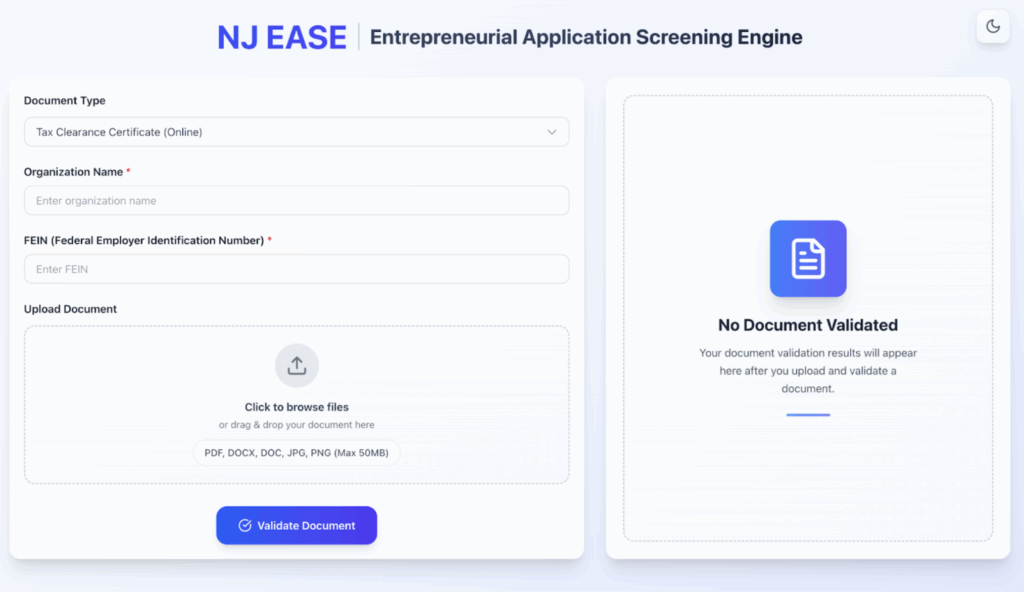
Solution: EASE (Entrepreneurial Application Screening Engine) is an AI-powered document-validation assistant that accelerates NJEDA reviews on two fronts: a standalone web app—ideal for existing applications—lets staff drag-and-drop a submitted document and instantly see pass/fail highlights, while an automated flow scans every file as soon as a new application lands in Dynamics 365 CRM, flagging issues before anyone opens the record. For each scan, EASE saves a concise PDF summary back into Dynamics that pinpoints missing or outdated items and lists out exactly how to fix them.
Impact: EASE removes the manual document-review bottlenecks that pile up into months-long backlogs, letting NJEDA staff shift their time from basic checks to high-value evaluation work. Because every upload is screened the moment it enters the system, errors are caught before they stall the queue—shrinking the “cure cycle” (the 10- to 40-day window applicants are given to re-submit correct paperwork) to a matter of hours. The result is a faster first-stage review, clear and actionable feedback to applicants, and a workflow that scales with rising application volume without demanding a proportional increase in staff.
Partners:
- New Jersey Economic Development Authority (Primary Stakeholder)
- Office of Innovation (Implementation Partner)
- Northeastern University’s Burnes Center for Social Change (Technical Development)
Problem Context
Background: Small businesses are New Jersey’s economic backbone, making up 99.6% of all businesses in the state and employing millions of people. Many of these businesses operate on thin margins and rely on NJEDA grants or loans to keep their doors open. When funding is delayed, business owners miss critical deadlines, employees face layoffs, and local economies feel the shock.
Urgency/Need: Since COVID and the election of Phil Murphy, the EDA’s budget has increased to millions of dollars. In 2024, $20 million was given in grants to boost state small businesses. Yet the surge in capital has been matched by a surge in demand: tens of thousands of entrepreneurs now file for aid every year. The result is a crushing backlog—applications can sit 8–12 months, sometimes longer, before money lands in owners’ accounts. During that limbo, shops miss rent, employees are laid off, and once-viable companies close their doors, costing jobs and tax revenue across NJ.
Target Audience:
- Primary Users: EDA product owners (reviewers) and technical staff
- Secondary Users: New product owner requiring training and onboarding
- Ultimate Beneficiaries: Small business owners and entrepreneurs across New Jersey
Innovation Process
Approach: We followed a blended human–centered and agile approach, moving through discover-define-design-deploy cycles in two-week sprints. At the outset we agreed on success metrics—speeding up the manual review process so staff can clear applications and release funds much faster—and met each week with NJEDA’s CTO, COO, and IT leads to keep security, scope, and timeline tightly aligned.
Co-Creation: Co-creation drove every design choice. We began with in-depth conversations with seven NJEDA employees—product owners, legal reviewers, and architects—to map the end-to-end approval flow. We then interviewed three small-business owners who had applied for NJEDA childcare grants; their stories revealed how unclear requirements and repeated uploads translated into month-long waits for funding. Once a working prototype was ready, we ran three weeks of live and asynchronous user-testing sessions with fourteen product owners. Their feedback shaped the validation logic, refined the document checklist, and helped us streamline the interface until 95 percent of test tasks were completed without assistance.
Data Sources: We ingested historical application PDFs exported from Dynamics 365 and paired them with NJEDA’s master compliance checklist to surface the most common error patterns. Those artifacts ensured that every rule we developed aligned with real reviewer pain points.
AI Solution Overview
What was built?
EASE pairs a one-click stand-alone web app with an always-on Azure Function that runs inside NJ EDA’s cloud. Whether a reviewer drags in a single PDF or an entire application arrives in Dynamics 365, EASE instantly inspects each document, pinpoints problems, and generates a clear, actionable PDF summary.
Key Features:
- Field-Level Diagnostics – Flags every missing or expired element (e.g., signatures, dates, seals) and lists the exact steps to fix them
- Cross-Form Consistency Checks – Cross-references core data (business name, FEIN, ID numbers) against the values the applicant entered elsewhere in the form, surfacing mismatches before staff ever open the file
Dual Deployment Options – EASE runs in two modes: a web-based stand-alone tool that lets staff spot-check legacy applications in seconds, and an integrated Azure Function that fires automatically on every new submission, generates a PDF summary, saves it to Dynamics 365, and alerts reviewers—no extra clicks required
Lessons Learned
What Worked: Wiring the Azure Function to Dynamics 365 via Power Automate proved rock-solid. As soon as an application hits “Submit,” the function scans every attachment, generates a PDF findings report, and drops it back into the applicant’s CRM record. Reviewers now open a case with a ready-made checklist instead of hunting through files—a workflow we validated end-to-end in UAT.
What Didn’t: Front-end validation for applicants remained out of scope. Our goal was an immediate “fix-it” warning the moment a business owner uploaded an incorrect file. Power Apps page-level constraints and time limits kept that feature on the wish list, leaving the EDA to rely on back-end triage for now.
Adaptability: The architecture is document-agnostic: swap in new field rules and the same pipeline can vet construction permits, medical intake forms, or university transcripts. A single JSON config drives what the function looks for, letting agencies replicate the solution without rewriting code.
Future Roadmap
- Application Frontend Integration: Embed the validator directly in Power Apps so business owners see errors the moment they upload a file—preventing bad documents from ever reaching staff and slashing cure cycles to a single submission.
- Batch Upload for Standalone Tool: Extend the standalone site with drag-and-drop batch upload. Reviewers will be able to drop an entire application’s folder, trigger parallel AI checks, and receive one consolidated results report—turning 30-minute spot audits into a sub-minute task.
Acknowledgments
Project Team: Kaushik Manivannan & Aarushi Thejaswi
Stakeholder Collaborators: Stephanie Pepen, Bruce Ciallella, Aruna Pandey, Thomas Murphy, Heather McCall
Organizational Partners:
- New Jersey Economic Development Authority (Primary Stakeholder)
- Office of Innovation (Implementation Partner)
- Northeastern University’s Burnes Center for Social Change (Technical Development)